Best Amateur Photo Contests to Enter in 2026

Top amateur photo contests around the world
The 20 competitions below represent the strongest opportunities for amateur photographers in 2026, spanning every genre from street and wildlife to fine art and mobile photography. Each one welcomes non-professional entrants, and together they cover a remarkable range of prizes, deadlines, and creative themes.
Amateur Photographer of the Year (APOY) — Over £24,000 in prizes across 10 themed rounds (Street, Landscape, Night, and more); free entry via magazine codes; Young APOY category for ages 13–21; open globally.
Sony World Photography Awards (Open Competition) — One of the most prestigious international stages for non-professionals; single-image submissions across multiple categories; winners receive Sony equipment and global editorial visibility.
International Photography Awards (IPA, Non-Professional) — Juried by curators and industry leaders; covers documentary, fine art, nature, and portrait; Lucie Award recognition for top finalists.
ND Awards (Neutral Density, Non-Professional) — Dedicated non-professional division with cash prizes and publication features; strong emphasis on conceptual and fine art photography.
Monochrome Photography Awards (Amateur) — Celebrates black-and-white imagery across all genres; open to amateurs worldwide with cash prizes and exhibition opportunities.
Fine Art Photography Awards (FAPA, Amateur) — Focuses on artistic vision and conceptual depth; winners gain gallery exposure and publication in respected art media.
iPhone Photography Awards (IPPAWARDS) — The original and most recognized smartphone photography competition; open to any iPhone model; prizes include cash and global press coverage.
Mobile Photography Awards (MPA) — Device-agnostic mobile competition covering street, nature, portrait, and abstract; celebrates the democratization of visual culture through handheld devices.
CEWE Photo Award — Free to enter with multiple categories under the theme “Our world is beautiful”; one of the largest amateur photography competitions by participation volume.
Siena International Photo Awards (SIPA, Open Categories) — Held in Siena, Italy; open categories welcome amateur entries; winners exhibited at the Siena festival, one of the premier meeting points in the contemporary art calendar.
Wiki Loves Monuments — The world’s largest photography competition by entry count; free to enter; focuses on documenting cultural heritage sites; winners contribute to the Wikimedia Commons archive.
Nikon Photo Contest (Open Category) — Backed by Nikon’s global network; open category accepts diverse subjects; prizes include Nikon equipment and international exhibition features.
Nikon Comedy Wildlife Photography Awards — Celebrates humor in nature photography; open to amateurs and professionals alike; significant cash prizes and widespread media coverage.
Travel Photographer of the Year (TPOTY, Amateur) — Dedicated amateur category within a globally respected travel photography award; prizes include travel vouchers and publication in leading travel media.
Minimalist Photography Awards (Amateur) — Rewards restraint and compositional clarity; open to amateurs; winners receive cash prizes and features in photography publications.
International Landscape Photographer of the Year (Amateur) — Amateur division of a globally recognized landscape award; prizes include cash and publication in the annual book.
Black and White Spider Awards (Amateur) — The leading international award dedicated exclusively to monochrome photography; amateur division with Photographer of the Year recognition.
Epson International Pano Awards (Amateur) — The world’s premier panoramic photography competition; amateur category open globally; winners receive Epson printing prizes and gallery features.
35AWARDS (Non-Professional) — Community-driven competition with a transparent public voting component; non-professional category with cash prizes and editorial features.
All About Photo Awards (Open Category) — Curated by photography specialists; open category welcomes diverse subjects and styles; winners gain gallery exhibition and publication opportunities.
Contest rules, prizes, and submission guidelines explained
Understanding the specific terms of each competition is what separates a strong entry from a disqualified one. The details below cover the most critical variables across the major competitions.
Eligibility: who qualifies as an amateur?
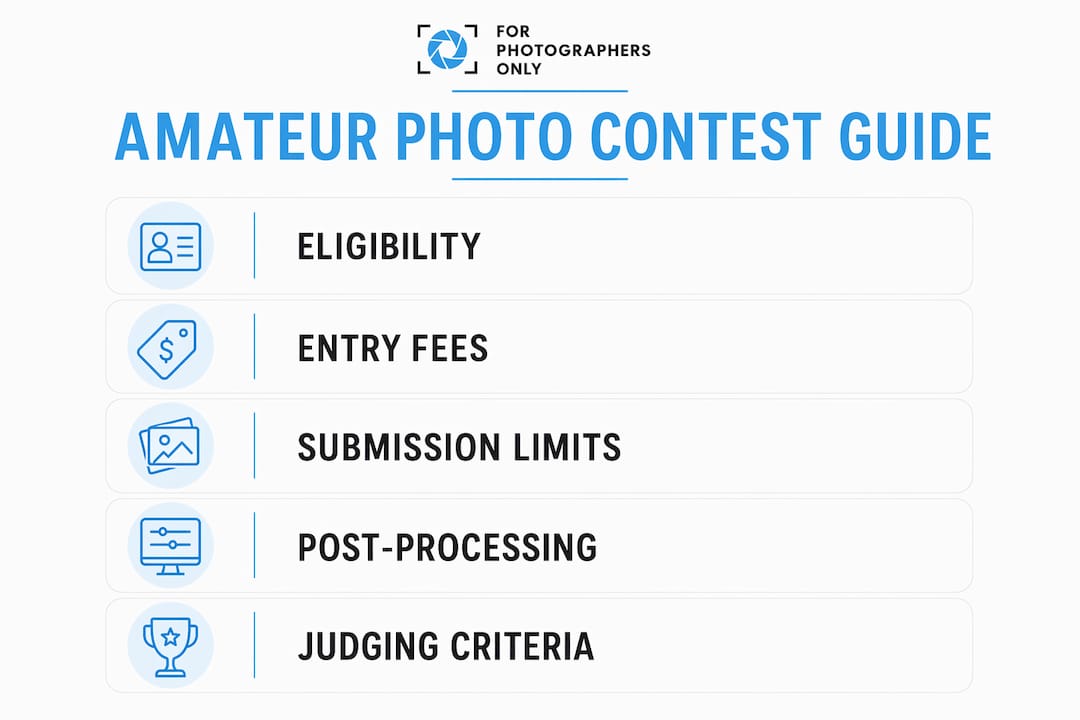
The most widely used definition across serious competitions is that an amateur photographer earns less than 50% of their income from photography. This standard appears in contests ranging from regional environmental awards to international open competitions. Some contests, like APOY, use a broader definition based on professional status rather than income percentage, so always read the specific rules before submitting.
Entry fees, deadlines, and submission limits
Contest | Entry Fee | Submission Limit | Prize Highlights |
APOY | Free (with magazine code) | Per round | significant total prizes |
CEWE Photo Award | Free | Multiple categories | Cash and equipment |
Wiki Loves Monuments | Free | Multiple images | Global archive feature |
Sony World Photography Awards | Free | Per category | Sony equipment, global press |
IPA Non-Professional | Paid | Per category | Lucie Award, cash |
ND Awards | Paid | Per category | Cash, publication |
IPPAWARDS | Paid | Per category | Cash, press coverage |
Epson Pano Awards | Paid | Per category | Epson printing prizes |
Black and White Spider Awards | Paid | Per category | Photographer of the Year |
35AWARDS | Paid | Per category | Cash, editorial features |
All About Photo Awards | Paid | Per category | Gallery exhibition |
Deadlines vary widely across the calendar year. APOY runs 10 rounds throughout the year, making it one of the most accessible competitions for consistent participation. CEWE typically closes in autumn, while the Epson Pano Awards and IPA both run annual cycles with spring-to-summer submission windows. Always verify current deadlines directly with each contest, as dates shift year to year.
Photo rights and usage after submission
Post-submission rights are a point many photographers overlook until it is too late. Most competitions retain the right to use winning and shortlisted images in promotional materials, publications, and exhibitions. The California Ocean & Coastal Amateur Photography Contest is a clear example: winning images may appear in Coastal Commission web pages, publications, and printed products. Reading the terms and conditions before submitting protects your work and prevents surprises.
Model releases and ethical compliance
Contests that include people in photographs often require contact information for any readily identifiable subject. The California Coastal Commission, for instance, reserves the right to disqualify an entry if the photographer cannot provide the name, address, and phone number of a recognizable person in the image when asked. Beyond legal compliance, ethical wildlife photography is equally enforced: the same contest requires photographers to maintain safe distances from marine mammals in line with the Marine Mammal Protection Act, with specific distance guidelines for whales, dolphins, seals, and sea otters.
Pro Tip: Before submitting any image featuring a recognizable person, secure a signed model release. Many serious contests will disqualify entries without proper documentation, regardless of artistic merit.
Post-processing rules
Most competitions permit standard adjustments such as exposure correction, cropping, noise reduction, and color grading, but prohibit adding, removing, or relocating subjects within a scene. HDR composites and panoramic stitching are generally allowed when the images are taken at the same location and time. Overly processed images risk disqualification at the judges’ discretion, so the guiding principle is that the final image should accurately represent what you saw through the viewfinder.

How to improve your chances of winning photo contests
The most common mistake photographers make when entering competitions is prioritizing technical perfection over narrative power. Judges across contemporary contests consistently favor images that tell a story or evoke an emotional response, even when the technical execution is imperfect.
What judges actually look for
Authenticity and vision carry more weight than pixel-level sharpness in most judging panels today. An image that sparks conversation or presents a new way of seeing a familiar subject will outperform a technically flawless but emotionally inert photograph. Thematic coherence matters too: if a contest has a defined theme, every element of your composition should serve that theme rather than merely relate to it.
Judges also assess images at thumbnail size during initial filtering rounds. A photograph that communicates its core impact at small preview scale, through strong composition, decisive lighting, and clear subject hierarchy, advances to the next round. An image that only reveals its qualities at full resolution often does not survive the first cut.
Practical strategies for stronger entries
Match your image to the specific category. Submitting a landscape to a street photography category, even a beautiful one, signals a lack of attention to the brief.
Enter multiple rounds or categories when permitted. APOY’s 10-round structure rewards photographers who engage consistently across different themes throughout the year.
Use free entry codes strategically. APOY offers free entries through its magazine subscription codes, reducing cost while maintaining access to one of the most prize-rich competitions available.
Experiment with unfamiliar genres. Entering a contest outside your comfort zone, such as minimalism or monochrome, builds compositional discipline that strengthens your work across all genres.
Track deadlines in advance. Planning submissions three to four weeks before a deadline gives you time to select, edit, and review your strongest work without rushing.
Contests like the Nikon Comedy Wildlife Photography Awards and the Minimalist Photography Awards reward photographers who commit fully to a concept. A half-committed attempt at humor or restraint rarely resonates with judges who have reviewed thousands of entries. Commit to the idea, or choose a different category.
Discover every opportunity with Forphotographersonly
Finding the right competition at the right time is itself a skill, and one that most photographers underestimate. Forphotographersonly exists to solve exactly that problem.
The Forphotographersonly directory currently features over 320 active international photography contests, awards, calls, prizes, grants, and competitions, all curated and verified by photography specialists. Over 100 of those are completely free to enter. The directory is updated every week, so photographers always have access to current deadlines, accurate entry fees, and verified prize details without spending hours searching across dozens of websites.
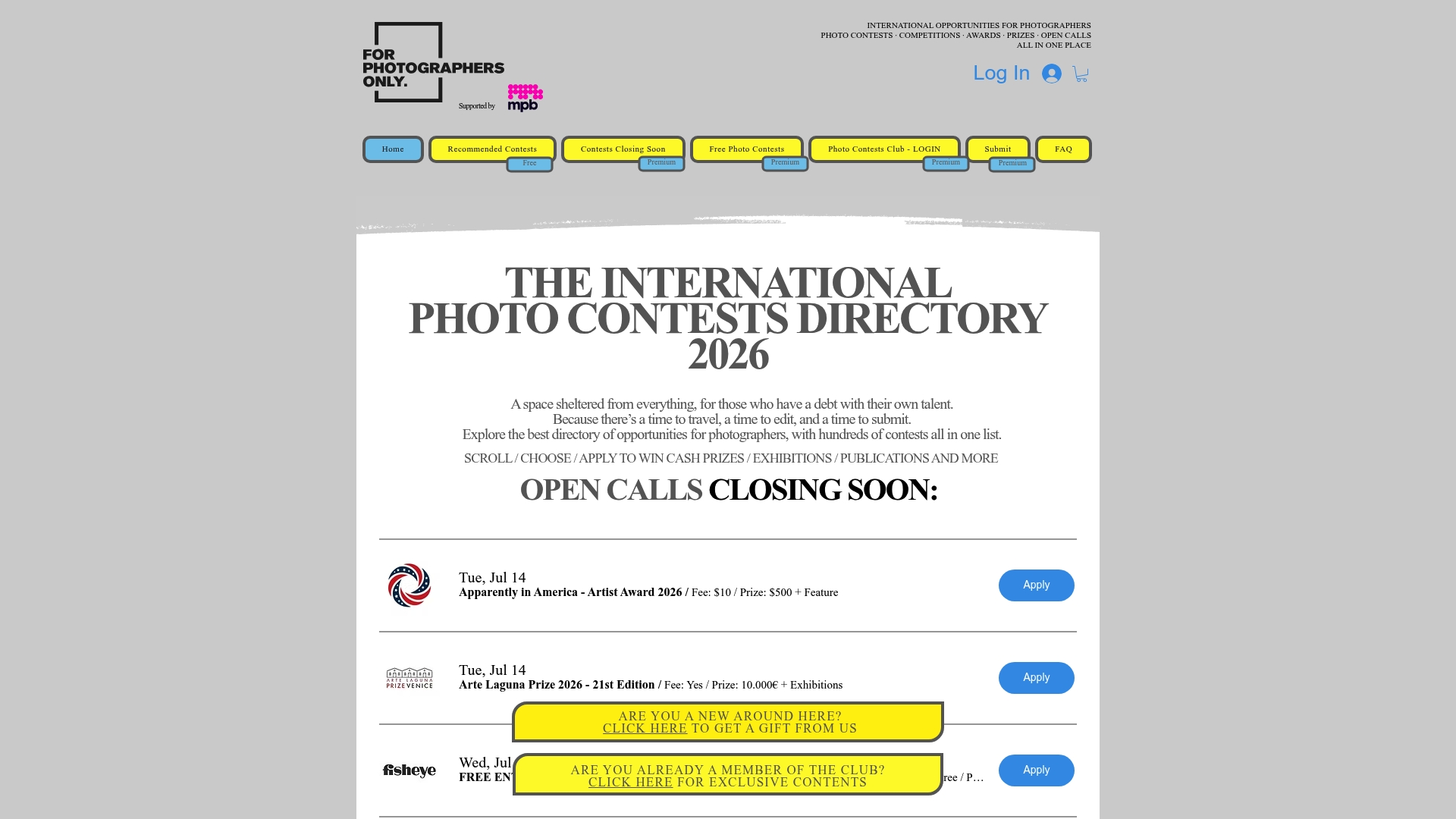
What sets Forphotographersonly apart from general search is the depth of each listing. Every contest entry includes the deadline, entry fee, prize breakdown, genre classification, and submission requirements, presented in a clear chronological format. The directory covers competitions from world-renowned brands such as Nikon, Canon, Leica, and National Geographic, alongside high-quality niche contests and independent festivals that rarely surface in standard searches.
Subscribers also gain access to a members-only internal competition and a community of photographers actively pursuing international recognition. For photographers serious about building a portfolio of achievements and increasing their visibility within the global photography industry, the full contest directory is the most efficient starting point available.
Access to the complete directory costs €6 per month. For photographers who want to build their online visibility alongside their contest presence, pairing a curated contest strategy with a strong digital footprint compounds the impact of every win or shortlist.
Key Takeaways
The strongest amateur photographers in 2026 treat contests not as lottery tickets but as structured creative challenges with clear rules, defined judging criteria, and real career value.
Point | Details |
Eligibility standard | Most competitions define an amateur as someone earning less than 50% of their income from photography. |
Free entry options | Contests like APOY, CEWE, Wiki Loves Monuments, and Sony World Photography Awards offer free entry, reducing financial barriers. |
Judging priorities | Storytelling, thematic coherence, and thumbnail-scale impact consistently outweigh technical perfection in judging panels. |
Rights awareness | Always read post-submission terms; winning images are routinely used in publications, exhibitions, and promotional materials. |
Directory advantage | Forphotographersonly tracks over 320 active contests weekly, including over 100 free-to-enter opportunities, saving photographers hours of research. |
Why contests deserve more of your creative attention
The conversation around photo contests tends to focus on prizes, and that framing undersells what these competitions actually offer. A cash prize or a piece of equipment is a one-time event. The creative discipline that comes from submitting work to a judged audience, repeatedly and across different themes, compounds over time in ways that are harder to quantify but more durable.
What strikes me about the strongest amateur photographers I observe entering competitions is that they treat each contest brief as a genuine creative constraint, not an obstacle. The Minimalist Photography Awards force you to strip away everything that does not serve the frame. The Monochrome Photography Awards removes color as a crutch and demands that light, texture, and form carry the entire image. These are not just competition categories. They are exercises in seeing differently, and the photographers who engage with them seriously come out the other side with a more disciplined visual vocabulary.
The community dimension is equally undervalued. Shortlists and exhibitions connect photographers with curators, editors, and fellow artists who share a commitment to the craft. The Siena International Photo Awards, for instance, place winning work in a festival context where the audience is genuinely engaged with photography as a cultural form. That kind of exposure does not appear on a prize list, but it shapes careers.
The practical advice matters too: read the rules, secure your model releases, and check your image at thumbnail size before you submit. But the deeper point is that the photographers who benefit most from competitions are the ones who enter with curiosity rather than just ambition. Use the APOY rounds to explore a genre you have never tried. Enter Wiki Loves Monuments and discover that documenting cultural heritage requires a completely different compositional approach than landscape or portrait work. Let the contest calendar shape your shooting, not just your submissions.
Recommended