AI Images in Photo Contests: What Is Allowed in 2026

Most photography contests in the United States still require that an image begin as a camera capture. Generative AI, meaning any tool that creates pixels from a text prompt, is excluded almost everywhere. Standard editing and AI-powered retouching are usually accepted, and a growing number of contests open a separate AI category for work that goes further. The rules differ from one contest to the next, so the safest habit is to read the AI clause before you pay an entry fee, and to keep your original files for as long as the contest might ask for them.
This guide explains where the line sits, how organizers check, what disclosure looks like and what happens when an entry crosses the line. It is written for photographers and visual artists in the U.S. and Europe who want to enter with confidence.
TL;DR
Text-to-image output, generative fill, generative expand and AI-inserted elements are prohibited in nearly every photography contest, unless a dedicated AI category exists.
Exposure, color correction, cropping, dust removal and, in many contests, non-generative AI tools such as denoise and sharpening are accepted.
Organizers may ask for RAW files, capture sequences or edit history, so keep your originals and your layered files.
A breach can mean disqualification, withdrawn awards and exclusion from future competitions, so disclose whenever the rules ask.
Check the contest’s AI clause, category list and verification terms before entering, every time, because they change from year to year.
Table of Contents
Where the line sits: AI-generated versus AI-edited
Contest rules tend to draw one distinction. An image made wholly or substantially by generative tools, or altered to add synthetic content that the camera never captured, counts as AI-generated or AI-assisted. The Pictures of the Year AI policy uses this definition, and it permits standard post-processing such as exposure adjustment, color correction, cropping and dust or blemish removal unless a category says otherwise.
The Boston Camera Club’s AI guidelines show the same split in plainer terms. Non-generative AI, which analyzes, enhances or modifies pixels that already exist, is allowed. Generative AI is not: anything produced from a text prompt, generative expand or AI insertion of birds, people or clouds that were not in the original is prohibited. Even sky replacement is allowed only when the new sky comes from the maker’s own photographs. Stock skies and AI skies are not. The club describes this as a clarification of an older principle, namely that the work must be photographic in origin and every element must derive from the maker’s own photographs.
A practical way to sort your own workflow:
Tool or action | Usually accepted | Usually prohibited |
Exposure, contrast, color correction, cropping | Yes | |
Dust and sensor-spot removal | Yes | |
AI denoise and sharpening on your own capture | Often yes | |
Minor object removal | Depends on the contest | Prohibited under stricter rules |
Generative fill or generative expand | Yes | |
Replacing a sky, background or subject | Only with your own photographs, and only if allowed | Stock or AI-made replacements |
Text-to-image or fully synthetic images | Only in a dedicated AI category | Yes |
The middle rows are where entrants get into trouble, because the same tool can be fine in one contest and grounds for removal in another.
What U.S. contests say right now
The policies below are a sample of the range you will meet. They are listed from strictest to most permissive.
National Geographic Your Shot. The Your Shot FAQ, published January 2, 2025, says AI cannot be used to generate or create an image or video in whole or in part, including generating elements, editing or enhancing. Only standard color correction and the retouching of sensor dust or film scratches is acceptable.
Professional Photographers of America (PPA). The PPA competition rules for 2027 prohibit whole or partial generative AI and text-to-image images. They require the raw camera file as part of registration and verification, and PPA reserves the right to disqualify or recategorize images that break the rules or undermine the integrity of the competition.
Capture Contests. Its creator guidelines prohibit generative AI content anywhere in its ecosystem, disclosed or not. That covers text-to-image, generative fill, generative expansion, object or background replacement, and AI-generated people, animals, skies or scenery.
Oregon State Fair. The 2025 photography rules state that AI-generated images are not photography and that every photograph must be made with a camera. Synthetic images and generative fill result in automatic disqualification, while AI-powered enhancement tools are allowed as long as they do not significantly change the image as a whole.
Austin Professional Photographers Association. Following PPA rules, APPA prohibits AI-generated content and stock AI images. It permits AI editing tools only when they add no new content, such as denoise, sharpening, minor object removal and basic adjustments, and it may ask for the original raw file.
NANPA Showcase. The Showcase AI rules declare generative AI output not allowed, with an exception for an Altered Reality category. Tools that enhance or retouch your own captured photo, including Topaz Denoise, Sharpen, Gigapixel, Photoshop and Lightroom, are permissible as long as the primary creative input remains with the photographer.
Foundry Day Arts and Crafts Festival. This juried show’s 2026 guidelines take a balanced approach for visual artists. The committee will not penalize AI tools used in planning or editing, but the final creation must be the artist’s work and not solely the product of a prompt. Artists are asked to disclose AI use in their descriptive statements, and work closely resembling a specific artist’s output is not allowed.
The pattern is consistent. The closer a contest is to documentary, editorial or professional-certification standards, the less room it leaves. Fine art and creative categories leave more.
Dedicated AI categories: a separate lane
Some organizers solve the problem by creating a place for synthetic or heavily AI-assisted work. That keeps it out of the photography categories and gives it a fair audience.
The PPA of Pennsylvania 2026 competition prohibits AI in entries except in its AI Fusion category. There, entrants show a thumbnail of their starting image and create a new image using AI prompts or techniques. AI Fusion entries are not eligible for artist merits, which is a good example of why you should read what an AI category does and does not earn you.
The NIPA 2026 rules accept AI-assisted work only in a dedicated AI category. The image must be based on a camera-captured photograph, and AI may be used only in editing, enhancement, retouching, compositing or creative post-production. Fully AI-generated images not based on a camera capture are not eligible. If you submit AI-assisted work outside that category, NIPA may move it to the AI category or disqualify it.
Two lessons follow. First, “AI category” does not always mean “anything goes”: some require a camera-captured source. Second, an image placed in the wrong category can be reclassified or removed, so choose the category deliberately. If you keep your source captures and editing steps well organized, with clear file names and metadata (an image optimization step by step routine covers the naming habits), proving the lineage of an image in an AI category becomes straightforward.

Disclosure: say it when the rules ask
Many contests do not stop at banning or allowing. They ask you to declare what you did. The Looking Glass On Rose contest rules are a clear U.S. example for entrants aged 18 and over. Each image must originate from an original real-world photograph made by the entrant. AI-assisted editing is eligible only when disclosed and when the image remains substantially grounded in the original capture. Prompt-generated or fully synthetic images are not eligible. At submission you state whether AI-assisted editing was used and briefly describe the tool or process. That information is used for eligibility review and is not shown to judges.
Disclosure can also be required for non-AI changes. Capture Contests notes that failing to make a required disclosure, for example about compositing, focus stacking or staged documentary scenes, may lead to disqualification even when the alteration itself was permitted. The lesson is that an honest note usually costs you nothing, while a missing one can cost you the entry.
A short disclosure that works in most forms names the capture, the software and the step. For example: “Single exposure, Lightroom global adjustments, AI denoise on the full frame, no elements added or removed.” Keep it factual and keep it consistent with your files.
How organizers check
No method is perfect, and the better policies say so. The Pictures of the Year authors state that no single method can determine an image’s origin with absolute certainty, so verification relies on cumulative evidence. Valid RAW files are regarded as strong evidence of photographic authenticity, but being unable to produce original files does not automatically indicate AI use.
In practice, organizers use a mix of requests:
RAW files at registration. PPA requires the raw camera file as part of verification.
Evidence on request. Looking Glass may ask for original capture files, a capture sequence, layered edit history or a brief process explanation, and failure to provide them may result in disqualification. NANPA may ask for additional information or evidence when there is reasonable doubt that a photograph was generated or significantly altered by AI.
Automated screening with human review. Capture Contests says it may use automated tools to flag potentially AI-generated, manipulated, duplicate or previously published work, but no entry is disqualified solely because of an automated indicator without human review.
For the photographer this is good news. A clean workflow protects you. If you shoot RAW, keep the original files and save layered edits, a request for proof is a ten-minute task. Our guide on RAW versus JPEG for contests explains why the format matters for exactly this reason.
What happens when the rules are broken
The consequences are written into the policies. PPA may disqualify or recategorize an image that violates its rules or undermines the competition’s integrity. Under the Pictures of the Year verification policy, an image judged likely AI-generated may be disqualified and any awards or commendations withdrawn. Serious or repeated breaches may lead to exclusion from future competitions. Entrants can appeal by submitting additional evidence, such as original capture files or workflow documentation, within the stated timeframe, and appeal decisions are final.
The damage goes beyond one lost entry fee. A withdrawn award affects the credit line in your bio, your relationship with the organizer and sometimes your standing with a community of judges who know one another. It is far cheaper to read the clause first.
A pre-entry checklist
Before you submit, work through these questions for each contest.
Is there an AI clause at all? Look in the official rules, the FAQ and the category descriptions. They sometimes say different things.
Which tools are named? Generative fill, generative expand, sky replacement and object removal are the usual flashpoints.
Does your category change the answer? Altered Reality, creative and AI categories often follow different standards from documentary or nature categories.
Is disclosure required, and where does it go? Some forms keep it away from judges, others place it in your artist statement.
What will you need to produce? RAW files, layered files or a capture sequence. Confirm you still have them.
What does the category earn? An AI category may not qualify for the same merits or titles as a photography category.
Is it the current year’s rules? Policies are revised often, so never rely on last year’s reading.
The broader point is covered in our article on reading AI photo contest rules first, and a look at the judging criteria rubric helps you decide which images are worth the entry fee in the first place.
Our perspective
Photography contests exist to celebrate a way of seeing the world: a moment witnessed, composed and carried through to the final print or frame. When AI enters the conversation, the strongest approach is the simplest one. Know what each organizer means by a photograph, and enter the contests whose definitions match your work. We do not run contests ourselves. We research, curate and publish international competitions in a clear, chronological list, so photographers can spend their time making images instead of hunting for rules and deadlines. With more than 320 active contests in the directory, including over 100 free to enter, you can choose the ones that suit your practice, whether you work strictly in camera or explore creative post-production. Our monthly internal competition and our photographer community give members a place to share work and learn from one another. We believe the most compelling portfolios are built on a steady rhythm of well-chosen entries, each one read carefully and submitted with confidence. DARIO
Find contests that fit your workflow
Keeping up with changing contest rules is hard when every entry means a new set of terms to read. PhotoContestsClub gathers more than 320 active international photography contests, awards, calls, prizes and grants on a single page, updated every week, with deadlines, fees, prizes and genres listed for each. More than 100 of them are free to enter. Membership is €6 per month or €40 per year, and a free trial is offered. You can see the full directory on the PhotoContestsClub page and compare the options on the plans and pricing page.
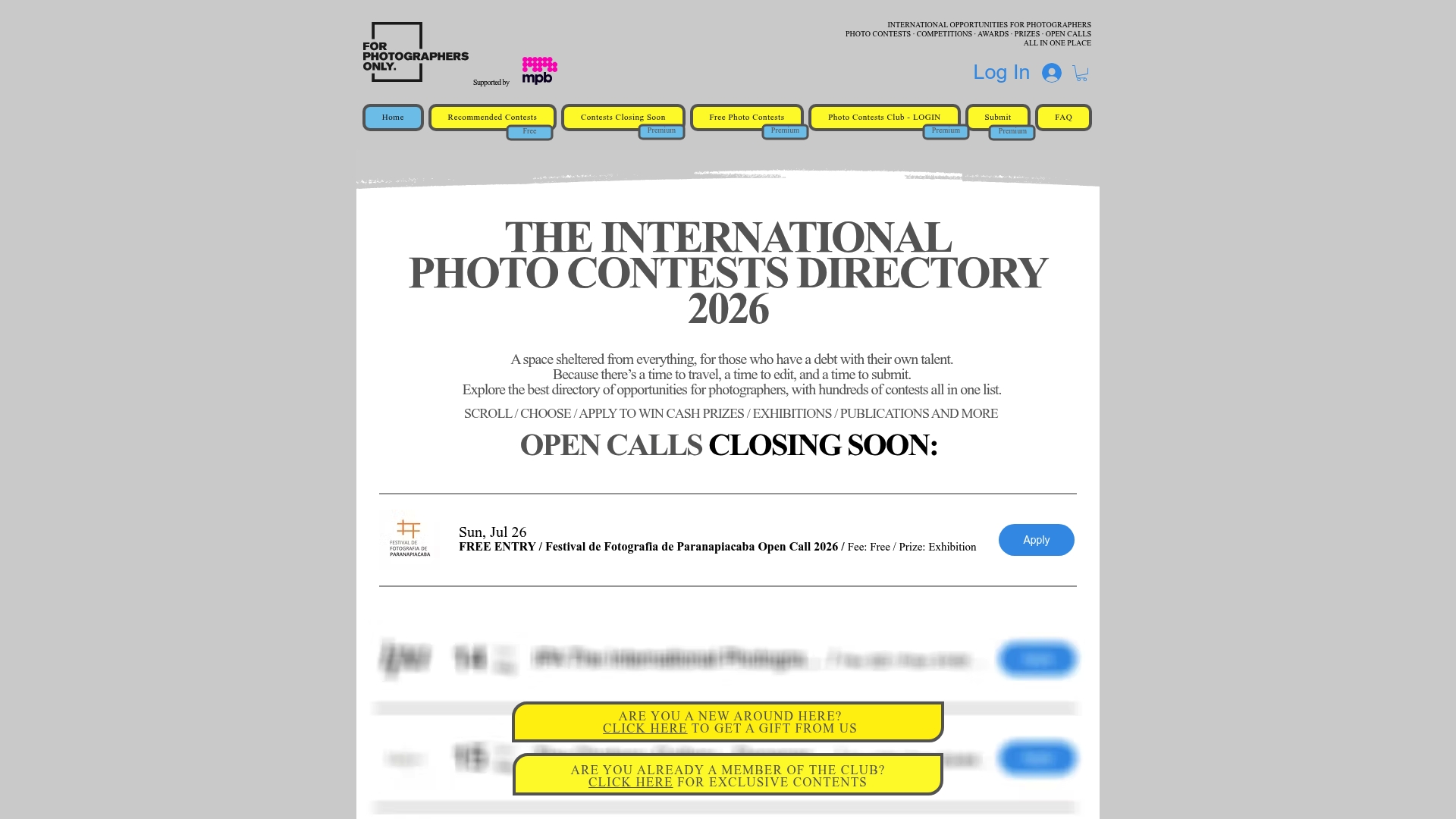
It is a practical way to shortlist contests by genre and fee, then spend your reading time on the AI clause of the few you actually plan to enter.
FAQ
Can I use AI-powered editing tools on a photo I enter?
Often yes, if the tool only improves your own capture. NANPA, for example, permits AI tools such as denoise and sharpening when the primary creative input remains with the photographer. Stricter contests, such as National Geographic Your Shot, accept only standard color correction and dust retouching, so check each contest’s wording.
Can I enter a fully AI-generated image?
Only where the contest has a category built for it. Most photography contests prohibit text-to-image work outright. Where an AI category exists, such as AI Fusion at PPA of Pennsylvania, read how it works: some require a camera-captured starting image, and some entries are not eligible for the same merits.
Do I have to disclose AI use?
When the rules ask, yes. Looking Glass, for instance, asks entrants to state whether AI-assisted editing was used and to describe the tool or process briefly, and uses that only for eligibility review. Failing to disclose something the rules require can lead to disqualification even when the edit itself was allowed.
Will organizers ask for my RAW file?
Some do. PPA requires the raw camera file for verification, and others such as Looking Glass and NANPA may request originals or edit history if a question arises. Keeping your RAW files and layered edits for each entry is the simplest protection.
What if I am disqualified and I did nothing wrong?
Check the appeal process. Under the Pictures of the Year policy, entrants can submit original capture files or workflow documentation within the stated timeframe, and the policy notes that lacking original files does not by itself prove AI use. This is one more reason to archive your originals.
Sources
Recommended